Rabu, 18 Juli 2012

In Trade Deal With Russia, U.S. Plans Sanctions for Human Rights Abuses


Published: July 17, 2012

WASHINGTON — In the two decades since the end of the cold war, the United States has extended its economic reach to the far corners of the old Communist world, establishing full-fledged trade ties with the likes of Ukraine, Armenia and Kyrgyzstan. Even still-Communist nations like China and Vietnam have been granted full trading status. But not Russia.

That seems about to change. For the first time since the fall of the Soviet Union, a bipartisan coalition in Congress has agreed to normalize trade relations with Russia, the onetime adversary in the long struggle between capitalism and communism. But at a time of renewed tension with Moscow, lawmakers have decided to grant the status with one large caveat — that Russian officials be held responsible for human rights abuses.

Selasa, 17 Juli 2012

Russian base in Tajikistan to remain for 49 more years

Tajikistan has agreed on the Russian version of an agreement on the deployment of the 201st military base on its territory. After 2014, the base will remain in Tajikistan without compensation. After the withdrawal of American forces from Afghanistan, the Russian base will be a guarantor of security for the republic from threats from the south.
.....
For Russia, the military base in Tajikistan is first and foremost a guarantee of its own security. China is also following in similar footsteps and planning to set up a base in Pakistan. When NATO contingent leaves Afghanistan in 2014, a war might break out in the region with renewed vigor and will easily spread to the neighboring countries, says a fellow at the Institute of World Economics and International Relations, Alexander Krylov.

This base is very important for Russia because it is located near the Afghan border and assures security at its outer approaches. After the U.S. pullout from Afghanistan, the situation in the region will worsen radically. It’s crucial for Russia to have means to respond to new challenges. The radical Islamists might try to cross the Afghan border. In these circumstances, the Collective Security Treaty Organization and the Shanghai Cooperation Organization can play the role of containing buffer which will stabilize the situation. The Russian military presence at the borders of the former Soviet Union will be a stabilizing factor. Not only Afghanistan, but also Iraq, Syria and Kurdistan will be the territory of a large war in the future. We are monitoring a single zone of instability and fighting the outcome of which is unpredictable,” Alexander Krylov said.

Senin, 16 Juli 2012

Russia lays charges over journalist's murder

Russia has charged a retired policeman with organising the 2006 murder of newspaper reporter Anna Politkovskaya amid an investigation that has been criticised in the West for taking too long.
.....
The Investigative Committee said on Monday it now believed that top former Moscow policeman Dmitry Pavlyuchenkov helped organise Politkovskaya's murder and helped track her movements for months.

The former head of the Moscow police surveillance department was arrested on August 23 and has since faced a series of different charges while continuing to deny all responsibility.

"Between July and September 2000, Pavlyuchenkov established the victim's place of residence, the route she takes [home], and reported this information to other members of the organised crime group," the committee said in a statement.

"Moreover, he obtained the weapon and ammunition that were later used in the killing," the statement added.

Minggu, 15 Juli 2012

Metropolitan hopes “NATO will break up”


PODGORICA -- Serbian Orthodox Church (SPC) Metropolitan of Montenegro and the Littoral Amfilohije once again said he was against Montenegro joining NATO

 “I hope to god that Montenegro will not join NATO that bombed us,” he told Podgorica-based daily Dan. 

Amfilohije believes that Montenegro would by joining the EU become a link in the military organization that “exerts violence on the entire world”. 


Jumat, 13 Juli 2012

Russian Ship Tries Again to Return Syrian Helicopters


by Jason Ditz, July 12, 2012
The Russian cargo ship the Alaed has left Russian waters again on an attemptto deliver refurbished Syrian helicopters back to the Syrian military. The last shipping attempt failed after British officials, under US pressure, forced the revocation of their insurance.
The Alaed had been a Curucao-flagged ship, and British officials made a big deal of having given serious considerationto launching a naval attack on the ship and capturing it to prevent the return of the helicopters. It was at this point the insurance was pulled and the ship slunk back to Murmansk.
This time, things are different. The ship has been reflagged as a Russian ship and while still traveling as a private vessel it is trailing not far behind a flotillaof Russian naval ships headed to the same area on a “training” operation.
Being a Russian-flagged ship removes the insurance obstacle, and the close proximity of the flotilla presumably will prevent Britain from giving serious consideration to attacking it when it gets close to British waters.

Kamis, 12 Juli 2012

Hidden in Afghanistan: Soviet Veterans of a Previous War Compare and Tremble

There are only a few of them left — deserters and MIAs of the huge Soviet Red Army divisions sent in to control Afghanistan. But they still remember how it all ended — and worry that the American war will end the same way

Even after three decades, Gennady Tseuma remembers the wavering call to prayer that went up clear over the hillside village. It floated out over the fields and river and pierced the early morning hush on the Bangi Bridge. Tseuma, then a Soviet soldier assigned to a small force guarding the river crossing in northern Afghanistan’s Kunduz province, recalls a feeling of dread when he heard the sound. Like many of the conscripts serving in the Red Army in Afghanistan, Tseuma was bored and undisciplined, and after 10 months of service, curiosity finally got the best of him.

The decision to investigate the call to prayer cost him the life he had known up to that point. “Our checkpoint was close to the village. Every morning the mullah did the call to prayer. It was totally new to me. I didn’t understand what was going on. I thought maybe they were killing people or something,” Tseuma tells TIME. “So, one day, early in the morning, I got off my base to take a look. When I got close to the mosque there was an old man sitting there. Then suddenly men with guns surrounded me and captured me. After that, the mujahedin told me to convert to Islam or they would kill me. I decided it was better to live than to die, so I became a Muslim.”

For the past 29 years, Tseuma and maybe around a hundred other Soviet POW/MIAs have lived through some of the most violent history of one of the most violent countries on earth. After serving in the European-style Soviet army, they lived and sometimes fought as Afghans. Those of them still alive have an extraordinary window into Afghan society combined with unique insight into the historical parallels between the Soviet defeat and the withdrawal of U.S. and NATO forces at the end of 2014.

Russia Sends Warships Toward Syria


The naval flotilla is a show of force and a reminder that Moscow will block any Western attempt to intervene against the Assad regime
by John Glaser, July 11, 2012
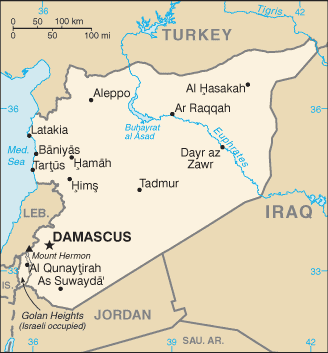
Russia has dispatched eleven warships to the eastern Mediterranean, some of which will dock in Syria, in Moscow’s latest attempt to display Russian power in the region and ward off a Western intervention in Syria.
About half of the ships are capable of carrying hundreds of Russian Marines, although its unknown if any forces are set to go ashore after docking at Russia’s naval base in Tartus.
The announcement came just one day after Russia officially said it would halt all new weapons sales to Syria. Russia has provide arms and backing to the regime of Bashar al-Assad throughout the 16-month long conflict.
Sending naval vessels, as Russia has done periodically throughout the past, seems an attempt to reassure the US and its allies that Moscow still plans to block any attempt to intervene militarily against the Assad regime.
Russia’s main concerns regarding Syria is that Washington will try to usher in regime change, and possibly military intervention, and exploit any political transition for their benefit, thus stamping out Russia’s valuable Middle Eastern ally.
UN envoy Kofi Annan said this month that while Russia has received a lot of criticism for continuing to back the violent President Bashar al-Assad’s regime, “very few things are said about other countries that send arms and money and weigh on the situation on the ground,” without naming any specific countries.
Foreign meddling on behalf of all sides has been instrumental in prolonging the conflict by emboldening both sides and making a political settlement more remote. But now Russia seems to be altering its posture to one of preventing any military intervention against Assad, instead of arming the regime as a proxy client. This position is more amenable to a resolution to the conflict, unlike the position of the US and its allies in arming and aiding the Syrian rebel fighters.